
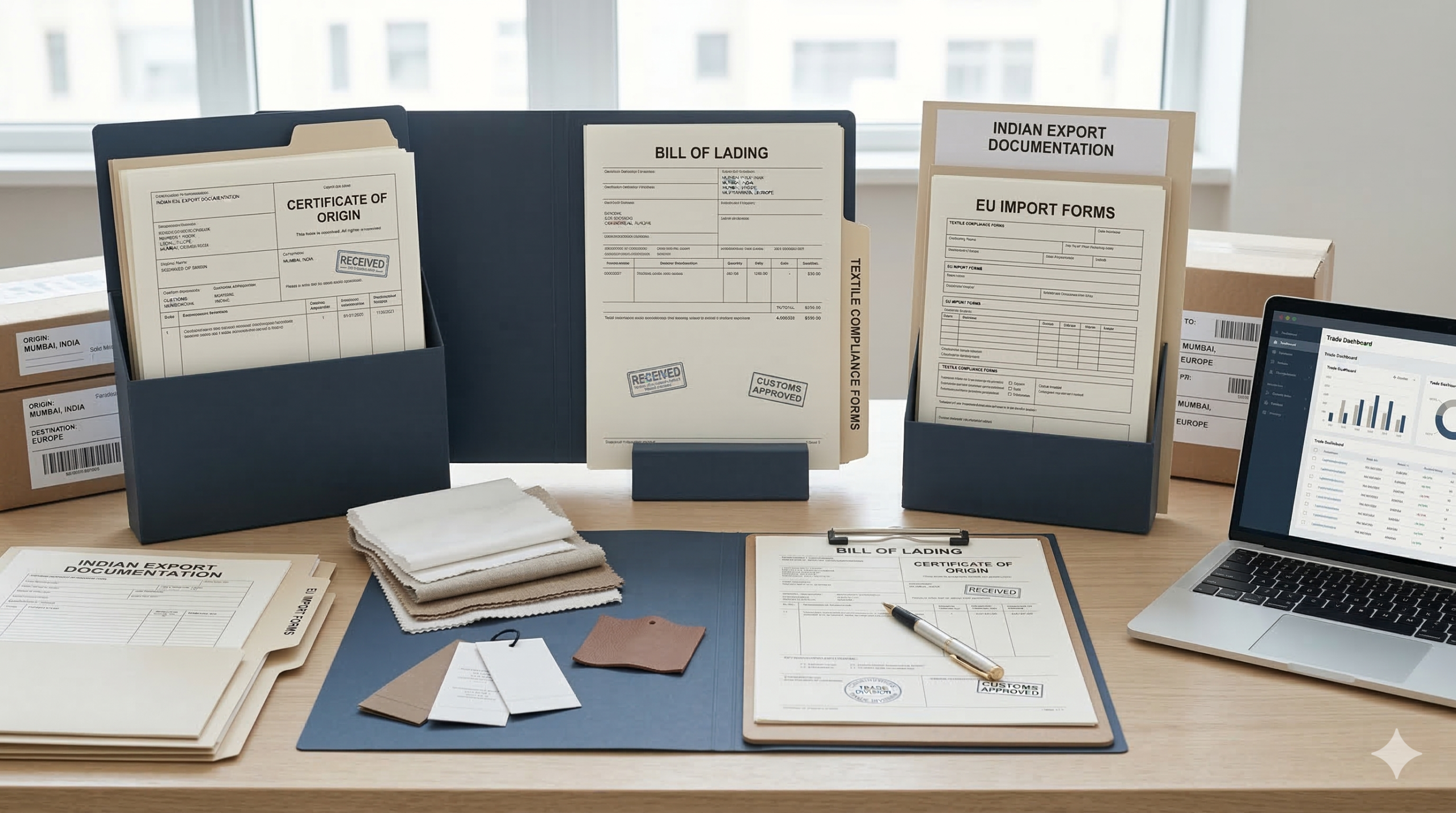

Importing apparel from India into the European Union (EU) is a valuable business channel especially as trade links deepen and new tariff benefits emerge. However, it also means navigating specific documentation requirements that ensure customs clearance, compliance, and smoother cross-border movement. Whether you’re sourcing garments for retail, wholesale, or private label, understanding these documents is essential for reducing delays and avoiding regulatory issues.
1. Commercial Invoice
The commercial invoice is one of the most fundamental documents in international trade. It provides a detailed record of the transaction between seller and buyer, including descriptions of the apparel, unit prices, total value, exporter and importer details, and the terms of sale. Customs authorities use this to determine duties and verify the declared value of goods. Without an accurate commercial invoice, clearance can be delayed or rejected.
2. Packing List
A packing list complements the commercial invoice by enumerating how goods are packed. It includes information on the number of packages, their weight, dimensions, and a description of contents. This helps customs officials physically verify shipments and reconcile invoices with the shipped goods. Though often overlooked, an accurate packing list accelerates inspections and reduces risk of hold-ups.
3. Bill of Lading / Air Waybill
Depending on the mode of transport, either a Bill of Lading (B/L) for sea freight or an Air Waybill (AWB) for air cargo is required. These act as proof of shipment and receipt of goods by the carrier. They also serve as important legal documents in the shipment contract between the exporter, carrier, and importer.
4. Certificate of Origin (CoO)
A Certificate of Origin confirms that the apparel being shipped originates from India. This document is crucial when preferential tariff schemes are applied under trade agreements. For example, Indian exporters may use systems like the REX (Registered Exporter System) to self-certify origin under EU trade regulations, helping importers claim reduced duties.
5. EORI Number (Importer Identification)
European buyers must have an EORI (Economic Operators Registration and Identification) number before importing into the EU. This unique identifier is required for all customs declarations and helps customs authorities track shipments and compliance. Without an EORI number, goods cannot be cleared through EU customs.
6. Customs Declarations and SAD/SAD Equivalent
Importers must file customs declarations, often using the Single Administrative Document (SAD) or its electronic equivalent, to formally declare goods to customs. This includes details like the Harmonized System (HS) code, value, weight, origin, and tariff classification. Correct HS coding is especially critical for apparel items since different garment categories attract different duties.
7. Additional Certifications (Product-Specific)
While basic apparel generally doesn’t require product safety declarations, some European markets and brands may demand additional documentation:
- Labeling compliances under EU regulations (for fiber content, care instructions, etc.)
- Sustainability and safety test reports such as REACH compliance for chemical safety
- Quality certifications (e.g., OEKO-TEX®) depending on buyer requirements
These are not always mandatory under EU customs law but are often required by brands and marketplaces to access shelves or online platforms.
In summary: importing apparel from India involves a structured set of documents that confirm the shipment’s value, content, origin, transport details, and compliance with EU customs rules. Being thorough and accurate with documentation is not just regulatory compliance it’s a commercial advantage that reduces delays, builds buyer trust, and facilitates smoother market access.